It is one of my favorite adventures that I have run for the dark I so far. -It’s a little bit Gangs of New York and Wolf of Wall Street at the same time. It is set in a city called Grangor inspired by the Hanse Mercantile Empire , it reminds you of Hamburg or Amsterdam. But there is also Venice in Grangor with all the channels. There is a murder mystery and stock speculation and bad investments. A really great detective adventure I wholeheartedly recommend it.
you can download my supplement in the scriptorium aventuris. it contains not only a timeline of the complicated events of this great detective adventure but also a list of all Suspects and other non-player characters dad appear in the adventure I also made quite a few handouts that will hopefully make for a better experience for your players. For example 1 newspaper with information about the city. And even tickets for the Opera. I also decided to put it on for free because there is so little content on the English version of scriptorium.
Bei Recherchen bin ich über Wehrkirchen gestolpert. Das sind Gotteshäuser die im Notfall auch als Verteidigungs dienen können. Diese erinnern mich stark an Tempel der Kriegsgöttin Rondra.
Bild unter CC-BY-SA von Michael SanderScreenshot mit Rondratempel aus dem Browsergame Herokon Online, dass inzwischen offline ist.
This article is for game masters of tabletop games like Dungeons and Dragons. I want to give you an idea of how a village in the post-Roman Manorialism looked on a map,so you can draw and describe such settlements in a way that makes sense. If your world does not know serfdom and feudalism as western Europe had it, this information will probably not apply to your game.
This article focuses on the late Middle Ages.
Layouts
The Middle Ages cover a very long period, ranging from about 500 AD to 1500 AD, depending on who you ask. Over that timespan, progress was made in the realm of farming and housing during the medieval times, albeit slowly. Thus the location and layout of towns may vary based on the time period and location.
In western Europe, the dominant feature of the medieval hamlet and village were the fields surrounding it. The farmland was divided into rectangular patches because turning the plow was cumbersome. This also led fields to feature a „ridge and furrow“ pattern- small dams building up to the left and right of the plow.
How much land a farmer had varied greatly. Most farms and houses had a small garden and a small plot of land for the livestock to dwell. Often there was a shared meadow or „common land“ that the villager’s animal could use for grazing- thus the name “commoner”. The farmland was worked in an open field system with 3 field crop rotation. The village’s fields were divided into 3 blocks: Fallow land that is left unused so it can replenish nutrients; spring planting; and autumn planting. Each farmer owned part of the land in each block. (See image Plan of a Medieval Manor) If your World has a different number or order of seasons, I recommend you invent your own crop rotation, or otherwise decide how much and how often one could yield crops from the ground until it needs to be left fallow. The open field system is thought to have been quite inefficient. It forced everyone to farm in the same way at the same time in what was called „flurzwang“ (lit. translation „field constraint“), which hindered innovation. Under an open field system, each farmer owns land dividing it into small non-adjacent patches that shrink each time the land is divided up between the sons (assuming such a system of inheritance). If your village has private ownership of land, the fields will probably be consolidated into blocks, like today.
image 2: a medieval manor with a row or street village and the surrounding lands , public domain from wikimedia commons
Estate- „Einzelhof“
Just an single estate the German word „einzel“ means single. To support a person, at least 18 acres of field is needed. These acres are divided among the 3-field system, so only 6 acres need to be tended to at any given time. This can go up to 12 or more acres depending on the climate and fertility of the soil. (see history.stackexchange.com)
a map of a estate with fields around it
„Einzelhof“-settlements as their field are usually in blocks, and not strips, as the other types of villages. An „Einzelhof“ or Gutshof, consits of the Lords Villa and a few farmers (2-5) houses to support the estate.
hamlet – „Weiler“
A Weiler consists of 3-20 farms, most commonly in random shapes. They occur as planned as well as random settlements. They were more common in western Germany. They sometimes grows into a „heap-village“, or in German „haufendorf“.
Heap – „Haufendorf“
image 1: Wiese = Maddow, Acker= farmland, Garten= garden – source: own work
The most common layout of a village is the „heap village“. The settlement has not been planned or ordered by a lord. Typically the shape is uneven and the placement of houses is random. Heap villages mostly occur when a Weiler or Einzelhof grows larger.
Row – „Reihendorf“
Wiese = Maddow, Acker= farmland, Garten= garden – source: own work linear settlement map of the German town Trebnitz
Linear settlements are orderly, like beads on a chain. The houses are lined up along a geographical marker, like a road, dam or river. These villages often were built by order of a landowner- the church, a lord, etc.. This mostly happened between the 12th and 18th centuries in Germany.
Depending on the density of the settlement and whether or not houses occur on both sides of the line, the terms Reihendorf, Zeilendorf, Straßendorf („street village“),Waldhufendorf (for timbering), or Marschhufendorf (next to a channel) may be used. They all are linear settlements with very similar layouts.
Circular – „Rundling“
a Rundling also called a circular village
The Rundling also belongs to the category of planned settlements. They can be found at the border of Slavic and Germanic culture. A common theory is that this setup was chosen because the structure can be defended more easily.
Angerdorf
The Angerdorf is a planned settlement as well that is built around an oval center. This central area usually has a water source for the livestock to drink. The lake also could be used to extinguish fires quickly. Sometimes a church is seen at the village center. This style of village was built by Germanic Tribes colonizing the eastern part of Germany and beyond according to a article on zeit.de.(includes a Map of were what type of village has been found)
Buildings
Farm houses
In Europe most farms were in the shape of the longhouse- a single room divided into several functional areas. In the later middle ages, richer farmers, often owning their land, could afford to erect several buildings and started to use foundations set in stone. The walls were typically timber-framed. „Wattle and daub“ construction was also common. Both constructions have the advantage of using less timber than other styles. They construct a frame which is then filled with straw, mud and clay. The roof was mostly thatched because tiles were very expensive. Only in the late middle ages did tile come back into popular use, mostly in cities to prevent fires.
Blueprint or floor plan of a farm house, a Hall b Kitchen with stove and oven c Living chamber with d oven and e niche for light f Sleeping chamber g Maiden chamber. Below, a cellar h Chamber i Hall to stall l Horse stall k Hayloft where farmhand sleeps, below feed box m Cow stall n Stall for temporary workers and feed storagee
All buildings were surrounded by a fence to keep the livestock close and wildlife out, and to protect the garden from the stock.
A woven wattle gate keeps animals out of the 15th century cabbage patch – public domain image from wikipeda
Sources
Even though focused on the farming and settlements of the turn of the 20th century, the images from the 1895 Book series by Meitzen has a lot of valuable illustrations, that are still helpful as inspiration if you don’t speak German. I recommend and link Volume 3, which contains most illustrations. There are a lot of farms and agricultural buildings with floorplans and blueprints. I uploaded a selection of the illustrations to flickr. They are all public domain.
August Meitzen: Siedelung und Agrarwesen der Westgermanen und Ostgermanen, der Kelten, Römer, Finnen und Slawen, Vol 1-3 available public domain at archive.org
August Meitzen: Siedelung und Agrarwesen der Westgermanen und Ostgermanen, der Kelten, Römer, Finnen und Slawen, Vol 1-3 available public domain at archive.org
Many will assume that „middle ages“-village or medieval town is a reasonable concept. It is not. The middle ages stretch roughly from 500-1500 AD. Also the planet is big. I will only talk about Germany, because that is what I researched.
if you’d rather stop being a eurocentric fool, like I still very much am, maybe start by watching this greatly entertaining introduction to the middle ages (at least including Arabic world too)
It was not until 1100AD before the development of Three-field system allowed for permanent farming settlements to become widespread: before that people often lived in a town for a few years until the ground was depleted and abandoned their town to move on. These „modern“ techniques let the ground be repopulated with nutrients, thus making permanent farming possible.
2. you couldn’t leave
feudalism ment serfdom and that ment being bound to the land your parents have been appointed to by the landlord. While there were free people, most people in medieval Germany lived as farmers in serfdom.
3. no one did leave
small late medieval farm
most townsfolk never left their town. And farmers made up 90% of the population.
4. life was hard a different way
A peasant worked less then a modern man . (or so a monk complaint about lazy pasents) There were long stretches of piece and if you survived childhood you lived well into your 40s. Food was good (fresh,all organic and local). There was a stretch of very mild climate in the middle ages , leading to good harvests. But also one misharvest and you might starve. Store you food wrong and you will starve in winter. Especially surviving in winter was not easy for the common volk.
5 being a women was a different kind of shitty
Men and women both had to work out of necessity. Modern day (or 1950s) gender roles where not around. Opression of women still was very real, but different from modern days.
closing words
This article aims to be useful in the context of tabletop rpg. Realism is a futile endevour, we lost a lot of knowledge about the middle ages. Also truth might not be fun to play. Heroes want to go on adventures, not be bound to land.
thanks to all the kind folks over at reddit who pointed out mistakes, that I will continue to fix.
Some time ago I made a tool for the German version of role playing game „the dark eye“ to create quick rules cheat-sheets for characters. A simple overview of all spells,special abilities and the like. I now made an English version as well:
I found the tool quite usefull, it runs on all things that have a browser. unfortunatelly I am not allowed to just put it online, so you will have to download it yourself from drivethrough. I hope you find this useful. 🙂
Your best option to make a character for the dark eye in English is currently the free Optolith hero generator . If you just want English character sheets you had to either buy the pretty pdf on drivethrough or print the ones from the core rules , a scan of which is available at ulisses us as direct download until now. For the German edition you can easily get a PDF with white background as a direct download. I don’t understand why this is not the case for the English edition of „the dark eye“, they clearly made a translated version (it’s in the core rules after all) , so removing the background seems trivial to me. So I changed translated the German PDF for all players to download directly without signing up at drive-throu rpg. I did, however, upload it there as well.
Bei D&D und Pathfinder sind Aufsteller und Miniaturen am Tisch üblich, bei DSA sieht man sie bisher eher selten. Als ich die Aufsteller für DSA von Ulisses gesehen habe, hatte ich sofort die Idee mir selbe welche zu basteln.
Das Scriptorium Aventuris bietet zahlreiche Illustrationen zum erstellen von Fancontent an. Diese habe ich dann genutzt um 2 Sätze an Aufstellern zu produzieren. Können durch klick auf Bild heruntergeladen werden:
Recently a shop called „the shop of many things„(secure archive.org link) started to aggressive advertise on Facebook and Instagram for their tabletop RPG related products. And by „their products“ I mean stuff they let other people ship to their customers directly from china („drop shipping“). Everything they sell is highly overpriced.
The alternative – the original
first things first: the elemental ink pen is just a rebranded pilot frixion temperature sensitive ink ball pen. the fancy original costs about 3$ a pop. white label versions are available as well for 1.50$ per piece in a lot of dollar stores. Go to a department store and take it home today instead of paying 10$ for the same thing + 20 days shipping at this online store.
So you picked up a original frixion pen or a relabled cheaper version? the online shop just talks about one hidden message, but we can do better! I will show how to hide 3 messages on one sheet for a cool puzzle for your campaign.
Write a hidden message for level 2 and a obvious one for level 1
take a permanent pen an write down your secret message in a blocky font (e.g. runes inspired writing). then take the erasable pen to mask the writing.
Alternatively prepare a longer text and only write the words/letters that spell out the secret message with a permanent pen. write the rest of your camouflage text with erasable ink.
Write and erase a message for level 3
finally write down a third and final message at a free spot on your paper using the erasable pen. Then erase it right away. this will be revealed when the sheet is cooled.
if you are not a rich person you probably don’t have a ice cooler around for revealing the message. Even if you do, it will take longer than you want in a role playing game. You can use any pressurized can instead. I recommend a 0.50$ body-spray. Yes, it will get some liquid on the sheet, but it’s much cheaper than cooling spray. Both work the same way: just like a tire gets hot when you pump it up and compress the air, the decompressed gasses inside the can withdraw heat from the surrounding to depressurize (it’s the ideal gas law). If you hold the can upside down you can reduce spillage on the paper.
demonstration of how to use a spray can to reveal heat sensitive ink
Example Secret
the level one Text is the following:
A spirited jig it dances bright, Banishing all but darkest night. Give it food and it will live; Give it water and it will die. Give it to me and it will be right.
riddle hinting at heating up the sheet it’s written on
hide the word „cool“ in permanent ink inside the word „food“ also the word me is permanent. So heat will reveal the level 2 text: „cool me“. Depending on your setting finding something in game that can cool down a sheet of paper can be a whole side quest! the level 3 Text can be whatever information you want to have delivered to your party. maybe the pass code to a bank locker?
The Science behind erasable ink
the Japanese company pilot invented the thermosensitive Metamo ink . The company is quite secretive about the details of their innovation, that , according to their claims, took three decades to bring to market. A nippon.com article explains that the ink contains capsules of color particles that contain a two part color molecule regulated by a catalyst. The compounds bound together in different configuration to be colorless or opaque, depending on temperature.
Für diverse Vorbereitungen beim Leiten benötigt man die Werte von Waffen. Zum Beispiel zum Befüllen von Kampfprotokollen. Ich habe jetzt dazu eine Liste aller Waffen aus dem Regelwiki von DSA ausgelesen und zu einer Tabelle gemacht
Darüber Hinaus gibt es ein schönes PDF im Scriptorium
Liste aller Waffen im Ulisses Regelwiki
Leider sind die Inhalte, wie zum Beispiel Waffen in DSA5 auf diverse Werke verteilt. Dafür gibt es gute Gründe. Aber es gibt ja das Scriptorium und das Regelwiki, sodass man sich einfach Listen erstellen und herunter laden kann. Das ulisses Regelwiki ist leider kein mediawiki mit dynamischen Listen, deshalb muss man manchmal selbst aktiv werden. Daher gibt es nun eine Liste aller Waffen im Scrptorium.
Eigentlich wollte ich nur „mal eben“ ein Kampfprotokoll erstellen. Dann ist mir aufgefallen, dass eine Tabelle mit allen Waffenwerten ganz praktisch wäre. Also habe ich einen webscraper erstellt, der mit die Daten aus dem Regelwiki in eine Tabelle schreibt. Das ganze hat 2 Stunden gedauert, das geht aber immer noch schneller als über 200 Waffeneinträge händisch zu übertragen. Es gibt so verrückte die das tun, z.b. ist beim Codex Completus wohl der Fall. Ich bin dazu aber zu faul. Die Liste ist also automatisch als tabelle vorhanden. Diese Tabelle habe ich dann mit Hilfe der Serienbrief Funktion in einen Index verwandelt.
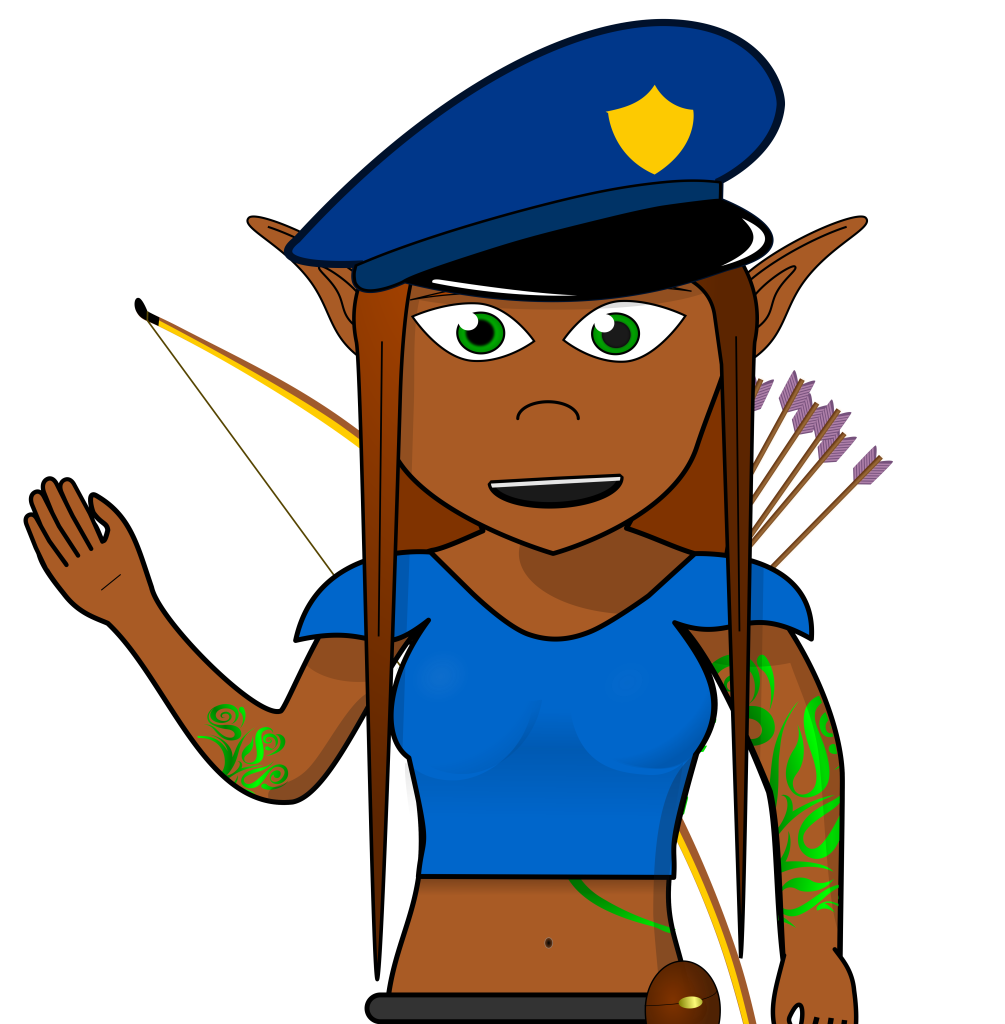
Die Rollenspielpolizei ist ein Meme in der Rollenspielgemeinschaft. Wenn jemand „falsch“ spielt dann kommt die Rollenspielpolizei und tritt dort die Tür ein. Die Rollenspielpolizei ist aber auch die Schere im Kopf. Sie hält Menschen davon ab zu spielen wie sie wollen, weil es ja kein „richtiges Rollenspiel“ wäre. Auch die Spieler*innen, die Neulinge durch gatekeeping von Rollenspiel abschrecken werden oft als Rollenspielpolizei bezeichnet.
Mir ist die Rollenspielpolizei leider auch außerhalb eines Witzes schon begegnet. Als ich an meinem ersten Abenteuer gearbietet habe kam ich an die Stelle, dass ich eine Kampf einbauen „musste“ . Die RPG-Polizei in meinem Kopf meinte, ich könnte ja wohl kein Abenteuer veröffentlichen ohne Gewalt und Kampf. Erfreulichweise habe ich aber dann den Questcast gehört. Das unterhaltsame Abenteuer „Satura nimmt, Satuaria gibt“ kommt in allen 7 Episoden ganz ohne Kampf aus. Das hat mich befreit. Es kann also helfen Vorbilder zu haben.
Die Rollenspielpolizei für andere
Viel substantieller sind die Erfahrungen mit der Rollenspielpolizei die Frauen machen müssen. Frauen berichten mir davon, dass sie sich nicht Zutrauen eigene Faninhalte zu verbreiten, weil sie glauben, dass ihre Werke nicht gut genug sind. Frauen werden im Rollenspiel viel stärker beäugt, sie werden oftmals nur als „Anhängsel“ wahrgenommen. Die Rollenspielpolizei prüft die Papiere und fällt das Urteil „keine echte Spielerin“. Sie ist nur wegen „dem Freund“ da. Eine Frau begibt sich in Gefahr, wenn sie sich mit Fremden allein trifft und kommt daher gerne in Begleitung. Das kommt den meißten Polizeikräften aber nicht in den Sinn. – Es muss also am mangelden Eigeninteresse liegen. Anna hat dazu ein Blogbeitrag verfasst, der seit 2017 nicht weniger aktuell ist.
Die Rollenspielpolizei vor die Tür setzen
Rollenspiel ist vielfältig. Als Spieler*innen können wir dazu Beitragen, dass es noch bunter wird in dem wir weniger Urteilen darüber wie andere Spaß haben. Ich für mich werde auch versuchen öfter ein zu wiedersprechen wenn sich andere zu „Wahrern des wahren Rollenspiels“ aufschwingen. Vielleicht helfen ja auch Memes.





 Glumbosch's Schmiede


